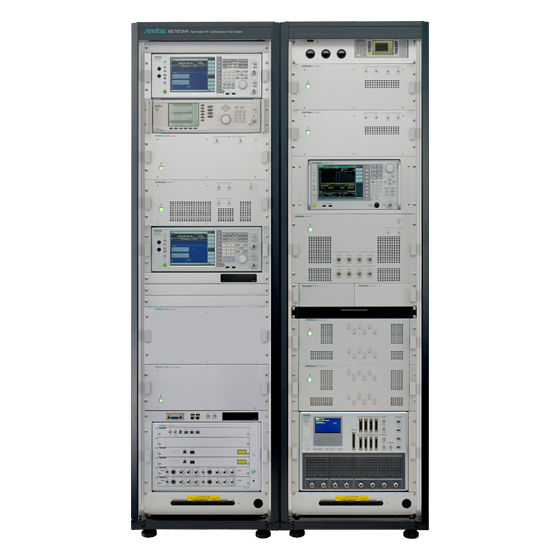
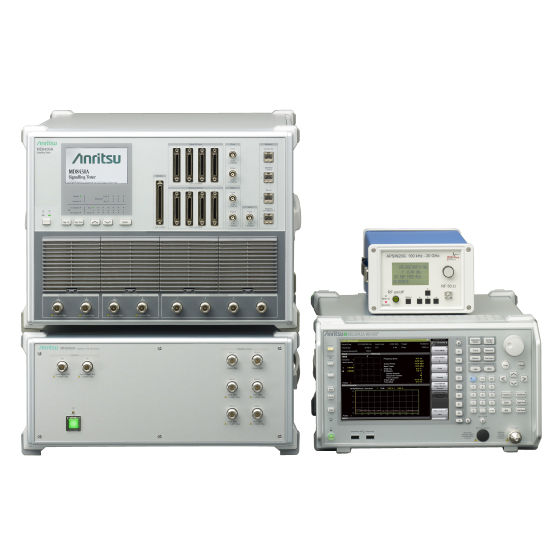
Base station simulator designed for developing LTE-Advanced Pro-compliant chipsets and wireless devices, supporting fault operation tests, an R&D test solution
Wireless devices are evolving quickly into multimedia smartphones with fast data connections due to widespread deployment of high-speed standards, such as LTE/LTE-Advanced/LTE-Advanced Pro. The Signalling Tester MD8430A is a key LTE-Advanced Pro base station simulator for developing LTE-Advanced Pro-compliant chipsets and wireless devices. In addition to verifying normal communications procedures, it supports fault operation tests, which are difficult to perform at connection with live base stations. It also supports LTE/LTE-Advanced/LTE-Advanced Pro terminal R&D and verification tests under various conditions. Moreover, LTE Cat-M/NB-IoT tests are supported. Based on extensive experience in 3G markets, Anritsu has developed the MD8430A as a powerful LTE-Advanced Pro protocol/R&D test solution to help developers bring LTE-Advanced Pro wireless devices to market as fast as possible.
A choice of MD8430A models designed for early chipset and UE development, function tests, and performance tests ranging from carrier acceptance to protocol conformance tests, plus retrofit upgrades between models, allows developers to customize their hardware investment to current needs while assuring flexible future upgrade options.
- Basic Test Model (BTM)
- M2M Test Model (MTM)
- LTE Enhanced Test Model (ETM)
Anristu MD8430A Signalling Tester Base Station Simulator
Features
- Supports LTE-Advanced Pro testing with 6CCs Carrier Aggregation (CA) and less
- Supports Dual Connectivity test
- Supports Licensed-Assisted Access (LAA) test
- Supports LTE-Advanced FDD/TDD Release 12
- Supports up to DL 6CCs and UL 3CCs for Carrier Aggregation (CA)
- One MD8430A supports CA handover, 4×4 MIMO and 8×4 MIMO, etc
- Supports full-digital fading test
- Supports DL 2 Gbps, UL 300 Mbps throughput test
- Inter-RAT tests making effective use of previous MD8480C (UTRAN/GERAN), and MD8475A (CDMA2000) hardware investments
- Optimized investment from first R&D to protocol conformance testing
- Full development and analysis toolset cuts L1, L2 and L3 scenario development time and costs
- Supports LTE Cat-M/NB-IoT
- Supports NB-IoT NTN (GEO)
- Supports LTE-Advanced Pro testing with 6CCs Carrier Aggregation (CA) and less
Specifications
Model/Name LTE Enhanced Test Model (ETM) Interface RF, Digital IQ, Baseband Fading*1 Frequency Band Max. 20 MHz UE Category Category 1, 2, 3, 4, 5, 6, 7, 9*2, 10*2, 11*2, 12*2
DL Category M1, 0, 1bis, 4, 6, 7, 9*2, 10*2, 11*2, 12*2,13*2, 15*2, 16*2,18*2, 19*2, 20*2
UL Category M1, 0, 1bis, 3, 5, 7, 13, 15, 20
NB Category NB1Max. Data Rate (DL) 1 Gbps (PHY: 2 Gbps) Max. Data Rate (UL) 300 Mbps MIMO 2×2 MIMO, 4×2 MIMO, 4×4 MIMO*3, 8×2 MIMO, 8×4 MIMO*4 Max. No. of Base Station Active + adjacent BTS: 8*5 (Max. Active BTS: 6) Handover (including at MIMO) Available*6 Carrier Aggregation:
No. of Component Carriers (DL)*76*8, *9, *10 Carrier Aggregation:
No. of Component Carriers (UL)*73*11 *1: Requires MD8430A-067 and two MD8430A sets for baseband fading. (ETM 2 sets or ETM & BTM)
*2: Requires two MD8430A sets. (ETM 2 sets or ETM & BTM)
*3: Requires MD8430A-075.
*4: Requires MD8430A-076.
*5: Requires two MD8430A sets. (ETM & ETM)
*6: Requires two MD8430A sets for inter-frequency handover of CA. (ETM 2 sets or ETM & BTM)
*7: Requires MD8430A-085.
*8: Requires MD8430A-088 for DL 4CA, requires MD8430A-089 for DL 5CA, and requires MD8430A-044 for DL 6CA.
*9: Requires two MD8430A sets for 3CA MIMO and 4CA MIMO. (ETM 2 sets or ETM & BTM)
*10: Requires two MD8430A sets for 5CA and 6CA MIMO. (only ETM 2 sets configuration)
*11: Requires MD8430A-045 for UL 3CA.Transmission Signal
Maximum Level Main connector: -40 dBm (Maximum setting level at Main connector: -20 dBm)
Sub connector: 0 dBmLevel Accuracy ±1.5 dB (Frequency Range: ≥350 MHz to ≤3800 MHz)
±2.0 dB (Frequency Range: >3800 MHz to ≤6000 MHz)
Main connector: -113 dBm ≤ Level ≤ -40 dBm
Sub connector: -113 dBm ≤ Level ≤ 0 dBm
* After calibration, 18° to 28°C, for calibration CWFrequency LTE: 350 MHz to 3.0 GHz, 350 MHz to 3.8 GHz (with MD8430A-002), 350 MHz to 6.0 GHz (with MD8430A-006)
W-CDMA: 400 MHz to 3.0 GHz, 400 MHz to 3.8 GHz (with MD8430A-002, MD8430 A-006)
GSM: 400 MHz to 2.0 GHz
Setting resolution: 100 kHzAccess Method LTE: OFDMA, W-CDMA: CDMA, GSM: TDMA Modulation Method LTE: QPSK, 16QAM, 64QAM, 256QAM
W-CDMA: QPSK, 16QAM, 64QAM
GSM: GMSK, 8 PSKModulation Accuracy At 18° to 28°C, Sub output: 0 dBm
LTE: ≤2%, (OFDM, 64QAM, 20 MHz band)
W-CDMA: ≤3.5%, (transmitting CPICH, ICH)
GSM: ≤1.5 deg. (GMSK), ≤3.5% (8PSK)Received Signal
Setting demodulation range
Based on the value set for the reference power
QPSK: -28 to +15 dB
16QAM: -21 to +15 dB
64QAM: -15 to +15 dB
(Input signal: EVM ≤ 1%, BER ≤1×10-12, 20 MHz band, SC-FDMA)
• Main connector input:
Reference power setting range: -20 to +20 dBm
However, within the input level range from -30 to +35 dBm
• Sub connector input:
Reference power setting range: -35 to +5 dBm
However, within the input level range from -45 to +20 dBmLevel Accuracy Main connector: ±3.0 dB
Sub connector: ±3.0 dB
* At 18° to 28°C, for calibration CW, within the Main input level range from -30 to +35 dBm, the Sub input level range from -45 to +20 dBm, and the reference power range of ±15 dBFrequency LTE: 350 MHz to 3.0 GHz, 350 MHz to 3.8 GHz (with MD8430A-002), 350 MHz to 6.0 GHz (with MD8430A-006)
W-CDMA: 400 MHz to 3.0 GHz, 400 MHz to 3.8 GHz (with MD8430A-002, MD8430A-006)
GSM: 400 MHz to 2.0 GHz
Setting resolution: 100 kHzAccess Method LTE: SC-FDMA, W-CDMA: CDMA, GSM: TDMA Modulation Method LTE: QPSK, 16QAM, 64QAM, 256QAM
W-CDMA: BPSK, 4 PAM
GSM: GMSK, 8 PSKSynchronization Acquirable Range LTE: ±100 μs (PRACH), ±30 μs (PUSCH)
W-CDMA: ±100 chips (PRACH), ±100 chips (DPCCH)
GSM: 0 to 63 symbols (SACCH)